
Tuscaloosa Address Eras and Sources
Begin with the era in question. Current tax records name an assessed owner, while deeds can extend the title chain into earlier books. Tuscaloosa directories add listed occupants from the twentieth century. Census schedules supply household evidence on one census date, and the Sanborn map shows the building rather than its residents. Gaps are real. Tuscaloosa County does not publish an exact start year for its online deed index, and surviving directory editions are not a continuous annual run.
| Source | Years it covers | Where held | What it shows |
|---|---|---|---|
| Assessor and valuation lists | Current; public PDFs for 2024 to 2026 | Tuscaloosa County Tax Assessor | Tax owner, parcel, value, and current address keys |
| Probate deed index | Online cutoff not officially stated | Probate Records & Recording | Recorded ownership events and title descriptions |
| Paper and microfilm deeds | Surviving series must be checked by catalog | Probate and Alabama Archives | Earlier grantor and grantee chains |
| City directories | 1913 to 1932 microfilm; selected editions through 2003 | Alabama Archives and public library | Listed names, addresses, and occupations by edition |
| Federal census | Decennial schedules through 1950 are public | National Archives and library databases | Households on the census date |
| Sanborn fire-insurance map | November 1899 | Library of Congress | Building footprint, use, and street context |
| Permits | Official online start not located | City or county request | Work dates and project roles |
For a recent transfer, start with the assessor and deed. For previous residents in the directory era, use the title chain and directory in parallel. Earlier work depends more on deed books, tax and census sources, probate, churches, newspapers, and the Tuscaloosa County microfilm catalog.
Fix the Tuscaloosa Parcel First
A present street number is only the entry point. Record the assessor parcel identifier, physical or situs address, owner mailing address, tax year, and legal description. The legal description is the title identity. It can preserve continuity when a road name, house number, postal city, or ZIP changes. This is especially important across Tuscaloosa County's large rural area and municipal edges, where a delivery name may not match the government that holds a permit file.
Keep an image or written extract of the current record. A later tax update should not erase the starting facts. If GIS and the assessor show different owner labels, use the dated assessor entry and recorded deed to resolve the gap. County maps derive from deeds, plats, wills, assessments, and surveys, yet the county states that they are tax tools and not valid conveyance records.
Tuscaloosa Deeds Reveal Past Owners
Tuscaloosa County Probate Records & Recording is the title backbone. It holds deeds, mortgages, releases, liens, and plats at the county courthouse. Address searches can miss older instruments because title records are organized around people and legal descriptions. Start with the current assessed owner, then follow the transfer parties backward.
- Locate the present owner's acquisition deed. Copy the grantee, grantor, date, book and page or instrument number, and legal description.
- Search that seller as a grantee in an earlier period. Confirm the same lot, block, subdivision, section, or other legal description.
- Repeat the transfer one deed at a time. Note mortgages or releases only for what those instruments state.
- When online results stop, call Records & Recording at 205-464-8206 or visit Room 121 for grantor-grantee and deed books.
- Search the Alabama Archives county catalog for a relevant Tuscaloosa record series when the local paper trail needs a microfilm route.
These terms keep the chain clear.
- Grantor and grantee
- The grantor transfers an interest; the grantee receives it in the recorded instrument.
- Chain of title
- The linked sequence of recorded transfers for the same land.
- Legal description
- The land description used in title records, which is more stable than a postal address.
- Criss-cross directory
- A publication arranged by street and number, used to find a listed name from an address.
Tuscaloosa Records Beyond the Web
The online deed cutoff remains a documented research gap. Earlier previous-resident work therefore needs a clear fallback chain: Probate's recording desk and deed books first, followed by the Alabama Archives County Records catalog. In the catalog, choose Tuscaloosa as the county, narrow by office when useful, and enter a singular record type such as “deed.” The catalog identifies records and microfilm; it does not mean every image is open online.
The captured Tuscaloosa County microfilm search shows the archive route.
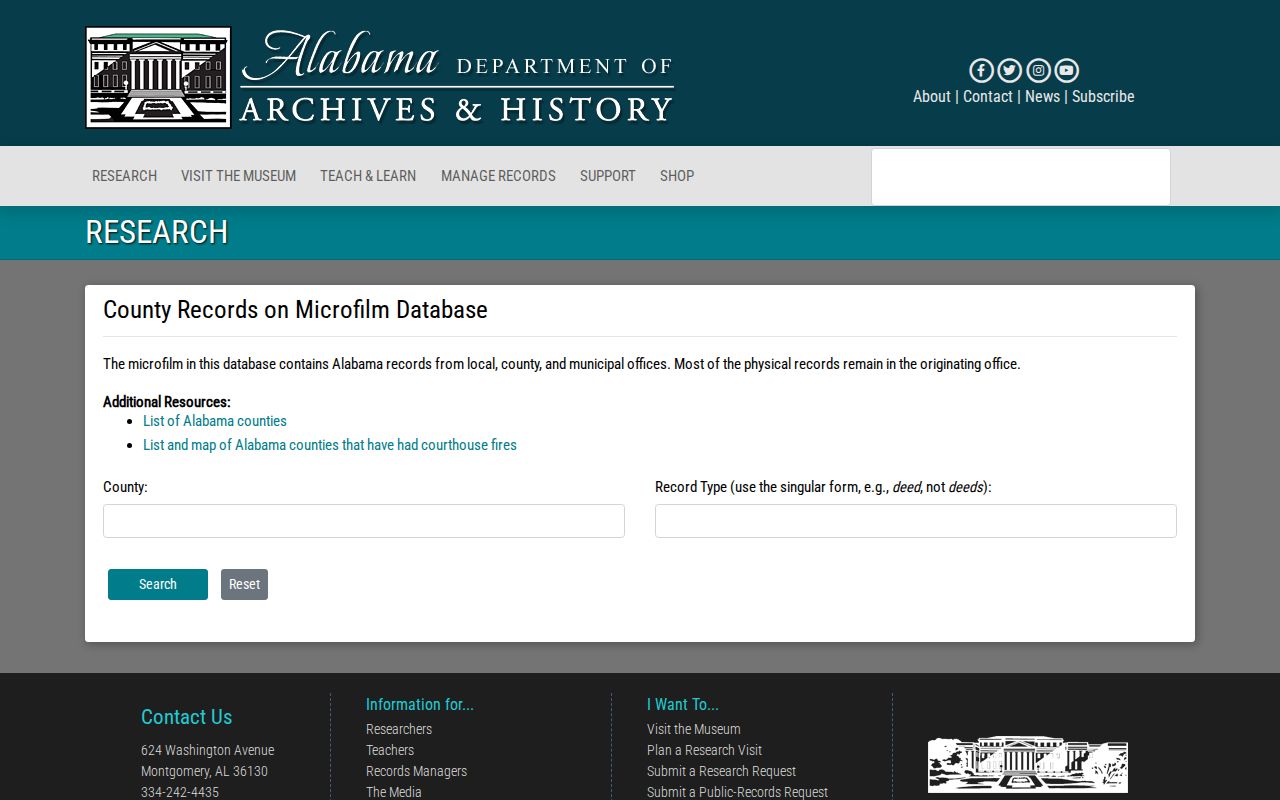
This fallback prevents an empty portal result from being mistaken for the start of local title. Tuscaloosa County was established in 1818, but no researcher should assume that every early series begins then or survives without a gap. Verify the book or film at the repository.
Note: The absence of an online deed is not evidence that a transfer never occurred; record the failed range and ask for the next index.
Tuscaloosa Previous Residents by Edition
Title identifies owners. Directories and census schedules can identify past residents who were listed at the place. Alabama Archives verifies Tuscaloosa directory microfilm from 1913 through 1932 and selected print editions from 1913 through 1973. Titles expand to Tuscaloosa and Northport for selected 1974 through 1997 volumes, then Tuscaloosa County for 1999 through 2003. Tuscaloosa Public Library also holds local city and telephone directories, though its public page does not list every year or confirm which books have reverse sections.
Use a dated process rather than treating first and last appearances as move dates.
- Check each available directory edition for the exact address, its prior spelling, or the named owner. Copy the name, spouse notation, occupation, and address as printed.
- Pair nearby editions with the public 1920, 1930, 1940, or 1950 census schedule. An enumeration district is the area assigned to one census taker.
- Compare household names and ages on the census date. Do not carry them into years the sources do not cover.
- Use a deed, obituary, cemetery record, or probate file to resolve a name change, death, or succession that explains the address trail.
The collection-level holdings and how to read entries are treated on the Tuscaloosa County city directory page. For house history, the goal is to use only the editions that intersect this one address.
Tuscaloosa's Seventeen-Sheet Map
The Library of Congress Tuscaloosa Sanborn edition contains 17 digital sheets from November 1899. It is a strong building source, not a resident roll. A sheet can show footprint, construction, use, nearby streets, and the setting of a structure. Pair it with a deed's legal description and a same-era name source. Never assign the map's building to a person without that bridge.
This free map is the most vivid surviving checkpoint in the address trail. It can explain why a later street number points to a rebuilt site, a changed use, or a parcel that was once split differently. If the modern number is absent, work from street intersections, lots, and title descriptions. No official countywide street-renumbering chronology was found, so visual similarity alone is not proof.
Tuscaloosa Past Residents and Changes
Building and code files can date an addition, demolition, repair, or other project. Request the exact address, parcel, type of file, and a narrow date span from the city or relevant local department. The named applicant may be an owner, contractor, agent, or responsible party. Preserve that role. A permit does not establish that the person occupied the home.
When a known past resident died, an obituary may connect a spouse, heirs, funeral home, and cemetery. Tuscaloosa Public Library holds local newspapers, surname and clipping files, cemetery and funeral material, and the Ferryman index of 21,613 person listings drawn from 26 weekly newspapers from 1821 through 1928. Probate estate files can then show a decedent, fiduciary, heirs, or property succession where the material is public. Some probate matters remain confidential, so request a named public file rather than an open-ended family search.
Tuscaloosa Resident Vital Endpoints
Vital certificates can confirm an event at the end of a previous-resident trail, but Alabama applies separate access rules to each type. State files begin in 1908 for births and deaths, August 1936 for marriage certificates, and 1950 for divorce certificates. Births remain restricted for 125 years and deaths for 25 years. Marriage and divorce certificates are unrestricted. Earlier marriage records belong with county probate research, while earlier divorce files remain a circuit-court question.
The ADPH vital-record form index provides the applications used for a proper request.

The form requires the record type, event details, applicant information, and authority for a restricted record. It supports a documented event search, not a browse of everyone once linked to a property.
The underlying rules are available in the Alabama Vital Statistics Law.
A certificate may confirm a date or relationship, but it does not make an adoption file or another sealed record public. Cite the certificate separately from the address evidence.
Limits on Tuscaloosa Address History
Previous residents do not form a complete public roll. Deeds omit occupants who held no title. Directories omit people, skip years, and may use abbreviations. Census data records one date and is closed for 72 years. Permit names prove project roles. Obituaries can contain errors, and tax maps can lag a deed. A sound answer states the source, its date, and what the named person was doing in that record.
Protected addresses must stay protected. Research into who lived here before is suited to family history, title context, preservation work, heir questions, and personal curiosity. It does not justify tracking a living person. For the modern parcel and current owner chain, the Tuscaloosa County street directory separates situs, mailing, GIS, and deed evidence.
Lawful use. Use Tuscaloosa County previous-resident records for legitimate house and family research. Do not harass, threaten, follow, or expose any living person.