
Tuscaloosa County Directory Shelf
The verified city directory trail comes from the Alabama Department of Archives and History finding aid. It starts with Tuscaloosa volumes, later joins Tuscaloosa and Northport under one title, and ends with countywide directories. These are selected holdings, not proof of annual publication. A gap in the list may mean the archive lacks that edition, not that no book was issued. Publisher names were not confirmed in the available official sources, so a citation should identify the title, edition year, repository, and format actually consulted.
| Directory collection | Verified years | Repository | How to consult it |
|---|---|---|---|
| Tuscaloosa city directories on microfilm | 1913–1932 | Alabama Archives | Reference-room microfilm |
| Selected Tuscaloosa print volumes | 1913–14, 1916–17, 1950, 1953–60, 1962–63, 1965–69, 1971, 1973 | Alabama Archives | Physical volumes; request exact year |
| Tuscaloosa & Northport directories | Selected 1974–76, 1978, 1980–81, 1984–85, 1988, 1991–93, 1997 | Alabama Archives | Physical boxes listed in finding aid |
| Tuscaloosa County directories | 1999–2003 | Alabama Archives | Physical boxes 125, 215, and 229 |
| City and telephone directories | Local run not enumerated online | Tuscaloosa Public Library Archives | Second-floor Reference Desk |
The archive listing itself requires care. Its 1963 line appears as “163,” an apparent typo in the finding aid, while other gaps are real gaps in the published inventory. Record the call location and page image as well as the printed year. That habit keeps a Tuscaloosa County city directory citation usable when two repositories describe the same run in different ways.
Tuscaloosa Directory Titles Evolve
The change in title is a useful local story. Tuscaloosa stands alone in the early verified run, Northport joins the named coverage during the 1970s, and the late series becomes countywide. That growth does not make every edition complete. It shows how the directory market widened with the area it sought to organize.
| Period | What the verified holdings show |
|---|---|
| 1913 | Earliest directory year verified in the Alabama Archives holdings. |
| 1913–1932 | A microfilm run provides the strongest early span. |
| 1974 | The listed title begins naming Tuscaloosa and Northport together. |
| 1999 | The verified shelf begins using a Tuscaloosa County title. |
| 2003 | Latest year named in the official state finding aid. |
No official source located for the research confirms the first locally printed directory, every publisher change, or the last volume on the public library shelf. Those points need inspection of title pages and the library inventory. The safe history is the one supported by the edition in hand.
Tuscaloosa Library Directory Access
The Tuscaloosa Public Library Archives and Genealogy collection is the main local access point when an edition is absent from a web catalog. Visitors sign in at the second-floor Reference Desk. Staff provide archive and microfiche access, and genealogy computers require a desk code. The collection includes Tuscaloosa and Northport directories, telephone books, yearbooks, newspapers, cemetery and funeral sources, family files, church material, maps, and local tax records.
The manifest view of the archives page shows the library route used for this historical search. It is a starting point for the city directory shelf, not an online image database.
Open the Tuscaloosa Public Library archives source before planning a visit.

The captured page confirms the dedicated archive and genealogy channel that connects directory research with local history sources.
For shelf questions, contact the genealogy desk at 205-345-5820 ext. 1270 or genealogy@tuscaloosa-library.org. In-library Ancestry Library Edition and expanded FamilySearch affiliate access can add census and catalog images that are not open from home. HeritageQuest is also featured. Printing costs are $0.10 for black and white and $1 for color, so notes and selective copies help control the cost.
Read Tuscaloosa Directory Entries
A period entry is compressed evidence. The alphabetical section commonly gives a surname and given name, may put a spouse in parentheses, and can add a widow notation, trade or occupation, and home address. A business section may identify an enterprise, proprietor, and address. Later street or criss-cross sections reverse the order, leading with the address and then the listed person. Symbols differ by volume, so claims about a mark should come from that edition’s own key.
| Listed name | Spelling used by the compiler for the named person. |
|---|---|
| Spouse or widow note | A family clue that still needs support from a vital, obituary, or probate source. |
| Trade or occupation | A time-specific affiliation, not proof of a later identity. |
| Home address | The street location printed for that edition. |
| Business entry | A public commercial name and place, which may differ from the home entry. |
Do not assume an owner or renter symbol appears in every Tuscaloosa city directory. The accessible official research did not expose a sample local page or abbreviation sheet. Photograph the title page, publication year, abbreviation key, and relevant entry before interpreting a short form.
- Criss-cross directory
- A section arranged by street and house number rather than by surname.
- Householder index
- An address-oriented list of the person identified with a household at publication time.
- Abbreviation key
- The volume’s own legend for short forms and symbols; it controls how an entry should be read.
- Edition gap
- A missing year in known holdings, not automatic proof that nobody published a directory that year.
Trace Tuscaloosa County Families
A city directory works best as a sequence. First and last appearances create brackets, not exact move or death dates. A person may vanish because of a move, omission, name change, death, or a missing volume. Each conclusion improves when the directory clue is paired with another source from the same period.
- Choose one target name or address and begin with the nearest available edition.
- Copy the spelling, spouse note, occupation, address, edition year, and page exactly.
- Check each surviving edition forward and backward, marking changes without filling gaps by guess.
- Pair 1920, 1930, 1940, and 1950 directory evidence with the matching public federal census.
- Test the end of the trail with a newspaper notice, cemetery record, probate file, or deed.
The 1950 census is the latest public federal population schedule as of the research date. Federal schedules open after 72 years, so the 1960 census is due in 2032. Enumeration districts and old street names can recover a family when a name index fails. For present-day address-keyed work, the Tuscaloosa County streets resource owns the modern parcel and street process.
Note: A directory appearance marks what the compiler printed for that edition; it does not establish an exact arrival or departure date.
Tuscaloosa Directory Meets Newspapers
The Ferryman’s Last Trip is an unusually rich companion to the city directory record. The index contains 21,613 person listings drawn from 26 Tuscaloosa County weekly newspapers published from 1821 through 1928. It can point toward birth and death notices, enlistments, visits, court items, and residents whose lives fall before or between surviving directory editions.
The index is a locator, not the final proof. Retrieve the underlying newspaper item, preserve its date and title, and compare the person’s age, kin, street, or community with the directory entry. Hoole Special Collections at the University of Alabama holds regional newspapers and other source runs used in this local research network. Tuscaloosa Public Library also keeps early West Alabama newspaper microfilm and The Tuscaloosa News.
Tuscaloosa County Reference Desk
The Tuscaloosa Public Library Reference Department gives researchers a direct route to staff, databases, and local material. Ask for an exact edition year, the alphabetical section, and any reverse or criss-cross section. When the online catalog lacks a year-by-year inventory, a narrow shelf question is more useful than assuming the volume is absent.
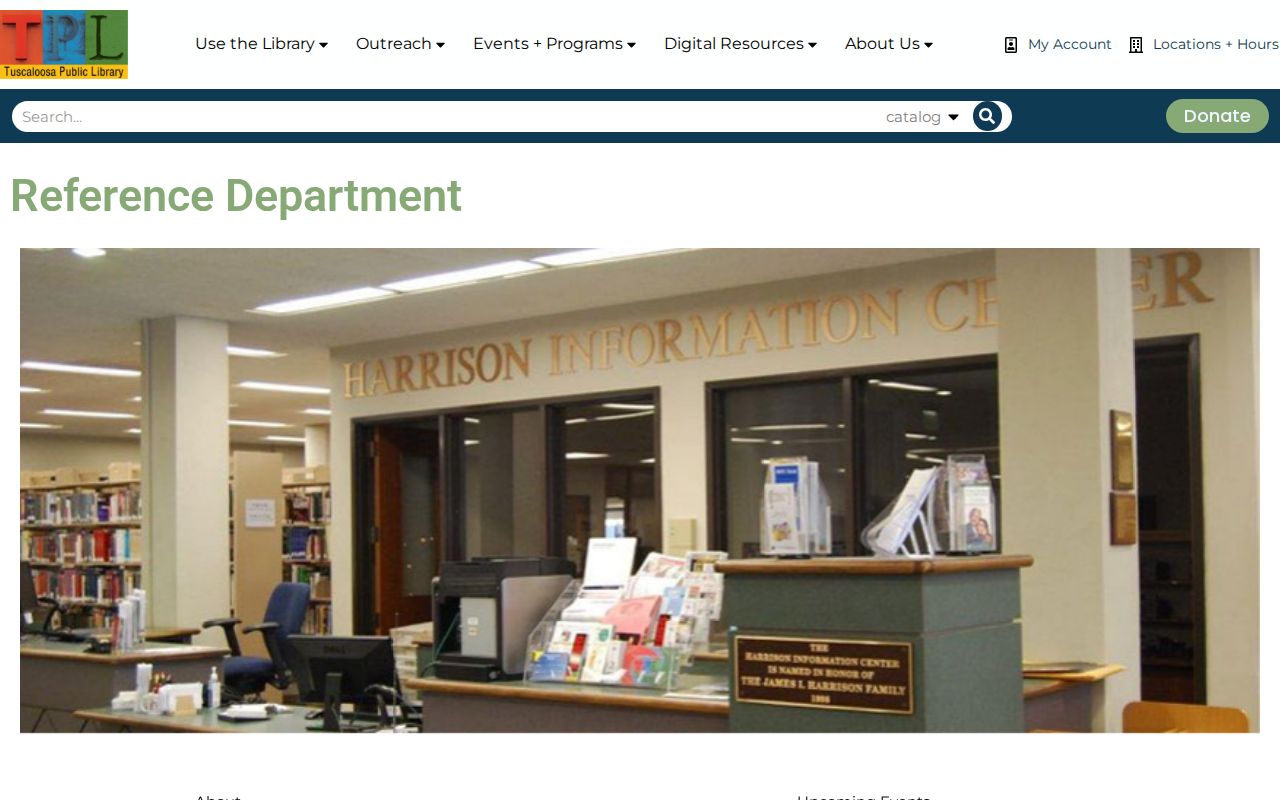
The reference capture reinforces that hands-on staff access is part of the Tuscaloosa County directory workflow, especially for microfilm and uncataloged files.
Surname and clipping files contain donated or compiled leads that a general catalog may not reveal. Treat them as guides to original records. Yearbooks may identify a classmate or school community, while church and synagogue collections may bridge years before state civil registration. Access to congregation records depends on repository permission.
Tuscaloosa Directory and Sanborn Map
The Library of Congress 1899 Tuscaloosa Sanborn map adds a building layer before the verified directory shelf begins. Its 17 free digital sheets show footprints, construction or use clues, and street context. They do not reliably name occupants. A sound comparison starts with the map’s sheet and street, then looks for a later city directory address and a deed legal description.
Old community names matter beyond central Tuscaloosa. The library’s place-name volume covers historic post offices and towns in Tuscaloosa and Greene Counties, including names such as Kellerman, Yolande, Holt, and Abernant. Those labels may appear in deeds, census schedules, or news items even after postal practice changed.
Extend Tuscaloosa Directory Research
When the city directories stop, the Alabama Archives supplies county microfilm and a Tuscaloosa loose-court-record index. Its County Records database asks for County, Office, and a singular Record Type such as “deed.” The catalog describes what exists; the record itself may still require a reference-room or microfilm request.
Use deeds, probate, obituaries, cemetery compilations, and church registers to test a directory clue. The six-volume Lambert cemetery set and Tuscaloosa marriage abstracts are strong local aids, but a compiled entry should be checked against a marker, certificate, newspaper, or original record. That chain turns a printed name into a supported Tuscaloosa County family history without treating a directory as a complete resident roll.